
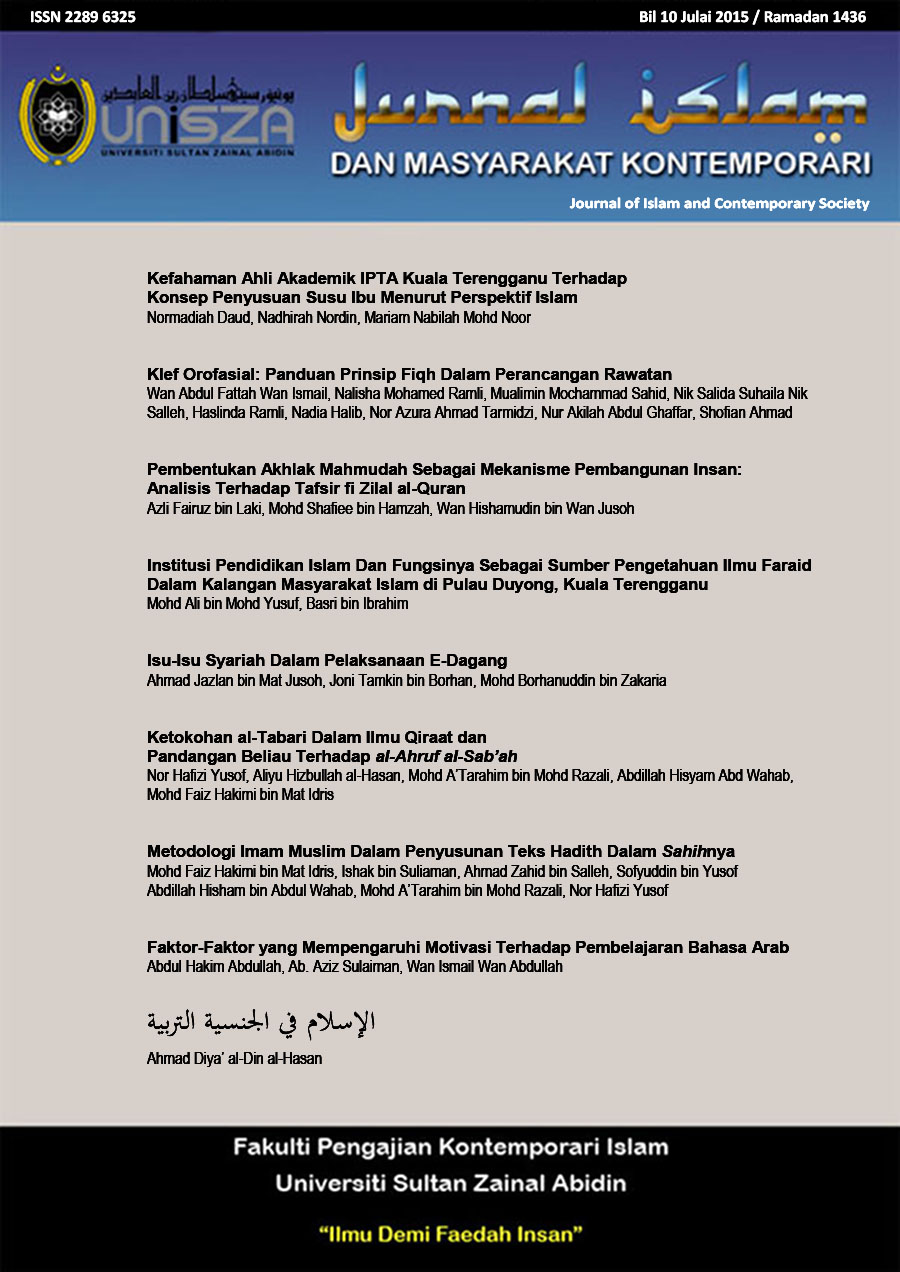
[The Formation of Mahmudah Morals as a Human Development Mechanism: Analysis of Tafsir Fi Zilal Al-Quran] Pembentukan Akhlak Mahmudah Sebagai Mekanisme Pembangunan Insan: Analisis Terhadap Tafsir Fi Zilal Al-Quran
DOI:
https://doi.org/10.37231/jimk.2015.10.2.107Abstract
Mahmudah morality is an important mechanism in human development. Man as a caliph is always exposed to morals mahmudah (praiseworthy) and morals mazmumah (reprehensible) throughout life on this earth. Thus, the Qur'an has used several methods in ensuring that human beings are developed with simple morals. Thus, this paper aims to look at the morals of the ignorant Arab society mentioned by the Qur'an and explain the methodology of the Qur'an in the formation of simple morals in developing their potential as superior human capital. To collect data, the author examines the contents of the Qur'an and collects verses related to the theme of morality. For the purpose of analysis, this study uses deductive methods to draw conclusions about the methodology of the Qur'an in applying simple morals in human beings. The results of the study found that the Qur'an uses four approaches in instilling good morals in human beings, namely the creation of role models, the narration of the stories of previous generations, parables and threats and encouragement. The four methodologies used by the Qur'an are able to ensure that good morals are always embedded in the self because it is an approach that is in accordance with human nature and instincts.
Akhlak Mahmudah merupakan mekanisme yang penting dalam pembangunan insan. Manusia sebagai khalifah sentiasa terdedah kepada akhlak mahmudah (terpuji) dan akhlak mazmumah (tercela) sepanjang kehidupan di muka bumi ini. Justeru, al-Quran telah menggunakan beberapa metode dalam memastikan manusia dibangunkan dengan akhlak mahmudah. Justeru, kertas ini bertujuan untuk melihat akhlak masyarakat Arab jahiliah yang disebut oleh al-Quran dan menjelaskan metodologi al-Quran dalam pembentukan akhlak mahmudah dalam membangunkan potensi mereka sebagai modal insan yang unggul. Bagi mengumpul data, penulis meneliti kandungan kitab al-Quran dan mengumpulkan ayat-ayat yang berkaitan dengan tema akhlak. Bagi tujuan analisis, kajian ini menggunakan metode deduktif bagi membuat kesimpulan tentang metodologi al-Quran dalam menerapkan akhlak mahmudah dalam diri insan. Hasil kajian mendapati bahawa al-Quran menggunakan empat pendekatan dalam menanamkan akhlak mahmudah dalam diri manusia iaitu pewujudan suri teladan, penceritaan kisah-kisah generasi terdahulu, perumpamaan dan ancaman serta dorongan. Keempat-empat metodologi yang digunakan al-Quran ini mampu memastikan akhlak mahmudah sentiasa tertanam dalam diri kerana ia merupakan pendekatan yang sesuai dengan fitrah dan naluri manusia.
References
Al-Ghazali, Abu Hamid (t.t), Ihya’ ulum al-Din, j.3. Mesir: al-Maktabah al-Tawfiqiyyah
Al-Mubarkafuri, Safiyurrahman, al-Rahiq al-Makhtum, Mesir: Dar al-Wafa’, 2000
Al-Bukhari, Muhammad bin Ismail, Sahih al-Bukhari, Kitab al-Nikah, no. hadith: 4834, j.5, Beirut: Dar Ibn Kathir, 1987
Abu Daud, Sulaiman bin al-Ash’as, Sunan Abi Daud, Kitab al-Nikah, no hadith 2274, j. 2, Beirut: Dar al-Kitab al-Arabiy, t.th
Micheal H. Hart (1978), The 100: a Ranking of the Most Influential Persons in the History. New York: Carol Pub. Group
Al-Maraghi, Ahmad Mustafa (1946), Tafsir Al-Maraghi, j.28. Mesir: Syarikah Maktabah Wa Matba’ah Mustafa Al-Halabi Wa Auladuh
Downloads
Published
Issue
Section
License
Submission of an article implies that the work described has not been published previously (except in the form of an abstract or as part of a published lecture or academic thesis), that it is not under consideration for publication elsewhere, that its publication is approved by all authors and tacitly or explicitly by the responsible authorities where the work was carried out, and that, if accepted, will not be published elsewhere in the same form, in English or in any other language, without the written consent of the Publisher. The Editors reserve the right to edit or otherwise alter all contributions, but authors will receive proofs for approval before publication.
Copyrights for articles published in JIMK journals are retained by the authors, with first publication rights granted to the journal. The journal/publisher is not responsible for subsequent uses of the work. It is the author's responsibility to bring an infringement action if so desired by the author.


